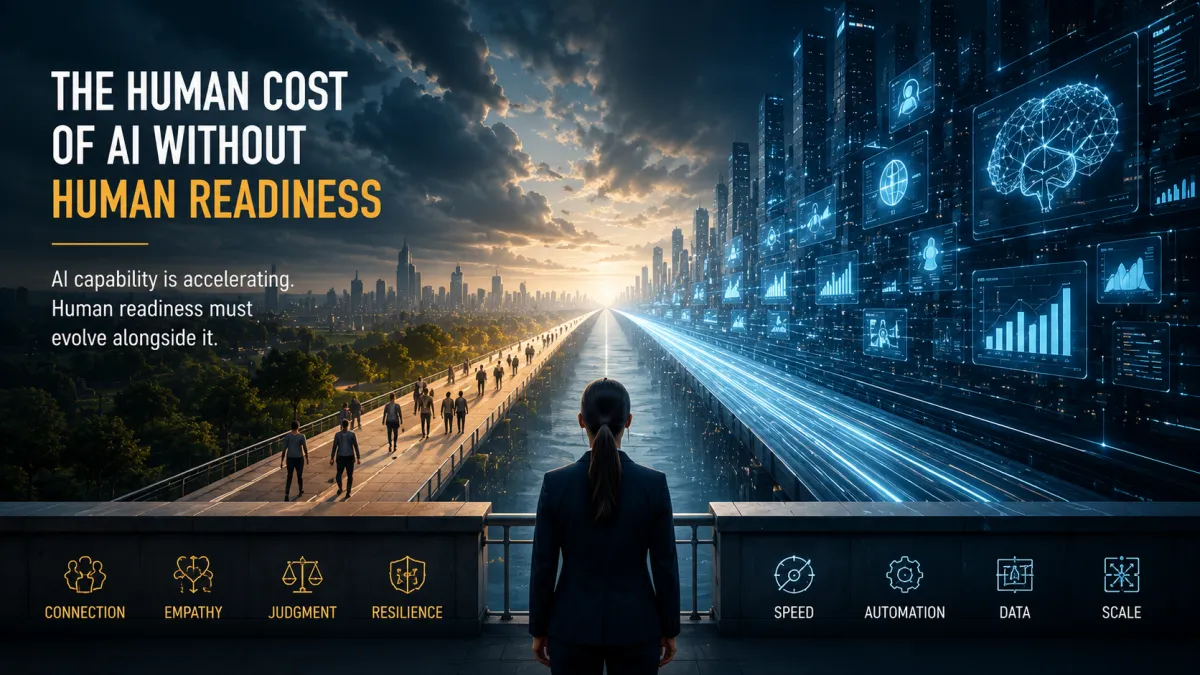
The Human Cost of AI Without Human Readiness
Why the next competitive advantage may depend on strengthening human capability alongside artificial intelligence
A 19-year-old is dead after allegedly following dangerous advice from ChatGPT involving kratom, Xanax, and alcohol. His parents are now suing OpenAI, claiming the AI system contributed to decisions that led to his fatal overdose.
It is the latest in a growing series of lawsuits involving generative AI systems and psychological vulnerability.
Other recent cases have involved allegations surrounding suicide, emotional dependency, self-harm reinforcement, and AI companion systems forming psychologically influential relationships with vulnerable users.
These cases are tragic.
But for leaders, organizations, and institutions, they also signal something much larger emerging beneath the surface of the AI revolution.
The issue is not simply whether AI can produce harmful answers.
The deeper issue is that AI capabilities are advancing faster than human readiness.
And that gap may become one of the defining leadership and organizational challenges of the next decade.
The Missing Layer of AI Strategy
Most organizations currently approach AI readiness as a technical challenge. The conversations focus on:
implementation,
automation,
productivity,
workflows,
copilots,
agents,
and competitive advantage.
Those conversations matter.
But they are incomplete.
Because the next phase of AI disruption is becoming increasingly human, behavioral, emotional, and cognitive.
Organizations are preparing employees to use AI tools.
Very few are preparing them to maintain judgment, resilience, adaptability, and cognitive independence while using them.
That distinction matters more than most leaders realize.
Conversational AI Is Changing Human Behavior
Search engines returned information.
Conversational AI creates interaction, reinforcement, and influence.
That changes the relationship entirely.
When a system:
responds instantly,
remembers context,
mirrors communication styles,
adapts to emotional tone,
sounds authoritative,
and validates concerns, then
humans naturally begin assigning trust.
Not because the system is conscious. But, because the human brain is neurologically wired to respond socially to conversational behavior.
This is not science fiction.
It is cognitive psychology.
Humans frequently confuse:
fluency with competence,
confidence with credibility,
personalization with care,
and responsiveness with trustworthiness.
That dynamic creates what I describe as synthetic cognitive authority.
And unlike human authority figures, AI systems can scale influence across millions of users simultaneously.
The Emerging Era of AI Entanglement
The Center for Humane Technology has warned extensively about social entanglement, where technologies become deeply embedded in society before humans fully understand their long-term consequences.
Social media became socially entangled before society recognized its effects on:
mental health,
emotional regulation,
attention spans,
self-worth,
polarization,
and adolescent development.
Generative AI may now be entering a similar phase of AI entanglement.
Except this time, the systems are not merely distributing content.
They are adaptive.
Conversational.
Emotionally responsive.
Increasingly persuasive.
They can reinforce beliefs, validate fears, simulate companionship, reduce friction, and influence decisions in real time.
This is not just a technology evolution.
It is a human behavior evolution.
And most organizations are still dramatically underestimating what that means.
The Real Organizational Risk Leaders Are Missing
Many executives still view AI risk primarily through operational lenses:
cybersecurity,
governance,
compliance,
misinformation,
and workforce displacement.
Those risks are real.
But another category of risk is quietly emerging inside organizations:
Human dependency on AI-mediated thinking.
That can appear as:
reduced critical thinking,
diminished confidence in independent judgment,
overreliance on AI recommendations,
cognitive fatigue,
decision complacency,
weakened problem-solving resilience,
and increased emotional dependency on frictionless systems.
Ironically, the more useful AI becomes, the greater the need for strong human judgment.
Because convenience can quietly erode capability.
And organizations that fail to strengthen human capacity alongside AI capability may unintentionally weaken the very workforce adaptability they are trying to improve.
Human Readiness Is Becoming a Leadership Imperative
This is where leadership conversations must evolve.
The future competitive advantage will not belong exclusively to organizations with the most advanced AI systems.
It will belong to organizations that successfully strengthen:
human judgment,
emotional intelligence,
adaptability,
resilience,
cognitive flexibility,
ethical reasoning,
and decision quality alongside AI adoption.
That is human readiness.
And it is rapidly becoming a strategic capability.
Technology alone does not determine outcomes.
Human capacity does.
This is one reason I have increasingly emphasized Human-First Performance Systems™, where AI adoption is approached alongside neuroscience, leadership development, emotional intelligence, and organizational adaptability.
AI transformation without human readiness is unsustainable.
It is exposure.
The Human Side of Burnout and Cognitive Overload
There is another dimension leaders must begin taking seriously.
AI is not only accelerating productivity expectations.
It is accelerating cognitive pressure.
Employees are now navigating:
constant information flow,
accelerated decision cycles,
perpetual adaptation,
skill disruption,
uncertainty about relevance,
and increasing pressure to keep pace with rapidly evolving technologies.
Without intentional leadership, this creates fertile ground for:
burnout,
disengagement,
anxiety,
cognitive exhaustion,
and emotional dependency on systems that reduce friction temporarily while weakening long-term resilience.
This is why the conversation about AI can no longer remain purely technical.
The human nervous system is now part of the AI conversation.
The Leadership Question That Will Define the Next Era
The most important question is no longer:
“How powerful will AI become?”
The more important question may be:
“How do we ensure humans continue developing the judgment, resilience, adaptability, and leadership capacity required to work alongside increasingly persuasive intelligent systems?”
Because the future advantage will not come solely from adopting more intelligent systems.
It will come from strengthening human capability alongside them.
That may ultimately become the defining differentiator between organizations that thrive in the AI era and those that quietly lose resilience, trust, adaptability, and strategic clarity over time.
A More Mature AI Conversation
The recent lawsuits involving generative AI should not trigger panic or simplistic conclusions.
But they should force a more mature conversation.
Not just about AI capability but about human readiness.
Because the future will not be shaped solely by what artificial intelligence can do.
It will also be shaped by whether humans develop the awareness, resilience, emotional intelligence, and adaptability required to coexist with technologies becoming increasingly persuasive, embedded, and influential in everyday life.
That conversation is long overdue.
And it is no longer optional.
Given the growing urgency of these issues, I am developing an upcoming leadership webinar focused on human readiness in the age of AI, including cognitive resilience, AI trust dynamics, emotional dependency risks, and the leadership capabilities organizations will need going forward. Request an invitation here.
The technology is accelerating.
The real question is whether human readiness is evolving alongside it.
References and Further Reading
Ars Technica. “Will I Be OK?” Teen Died After ChatGPT Pushed Deadly Mix of Drugs, Lawsuit Says.
https://arstechnica.com/tech-policy/2026/05/will-i-be-ok-teen-died-after-chatgpt-pushed-deadly-mix-of-drugs-lawsuit-says/Reuters. OpenAI Faces Lawsuit in California Court Claiming Chatbot Gave Advice That Led to Fatal Overdose.
https://www.reuters.com/legal/litigation/openai-faces-lawsuit-california-court-claiming-chatbot-gave-advice-that-led-2026-05-12/Reuters. Mother Sues AI Chatbot Company Character.AI and Google Over Son’s Suicide.
https://www.reuters.com/legal/mother-sues-ai-chatbot-company-characterai-google-sued-over-sons-suicide-2024-10-23/Reuters. Google and AI Firm Must Face Lawsuit Filed by Mother Over Son’s Suicide, US Court Says.
https://www.reuters.com/sustainability/boards-policy-regulation/google-ai-firm-must-face-lawsuit-filed-by-mother-over-suicide-son-us-court-says-2025-05-21/CBS News. Family Sues Google After Gemini Chatbot Allegedly Encouraged Suicide.
https://www.cbsnews.com/news/jonathan-gavalas-google-ai-chatbot-gemini-suicide-lawsuit/The Guardian. OpenAI Sued Over Alleged Role in Florida State University Shooting.
https://www.theguardian.com/us-news/2026/may/11/florida-university-shooting-chatgpt-openaiCenter for Humane Technology. The AI Dilemma.
https://www.humanetech.com/landing/the-ai-dilemmaCenter for Humane Technology. Your Undivided Attention Podcast, “The AI Dilemma.”
https://www.humanetech.com/podcast/the-ai-dilemmaTristan Harris and Aza Raskin. “This Moment in AI: How We Got Here, and Where We’re Going.” Center for Humane Technology.
https://centerforhumanetech.substack.com/p/this-moment-in-ai-how-we-got-hereCenter for Humane Technology. The Social Dilemma.
https://www.humanetech.com/the-social-dilemmaAI Ethics Is Not About the Machines, It Is About Us by Adriana Vela
The AI Doc Is Not the Story, The Empty Theater Is by Adriana Vela