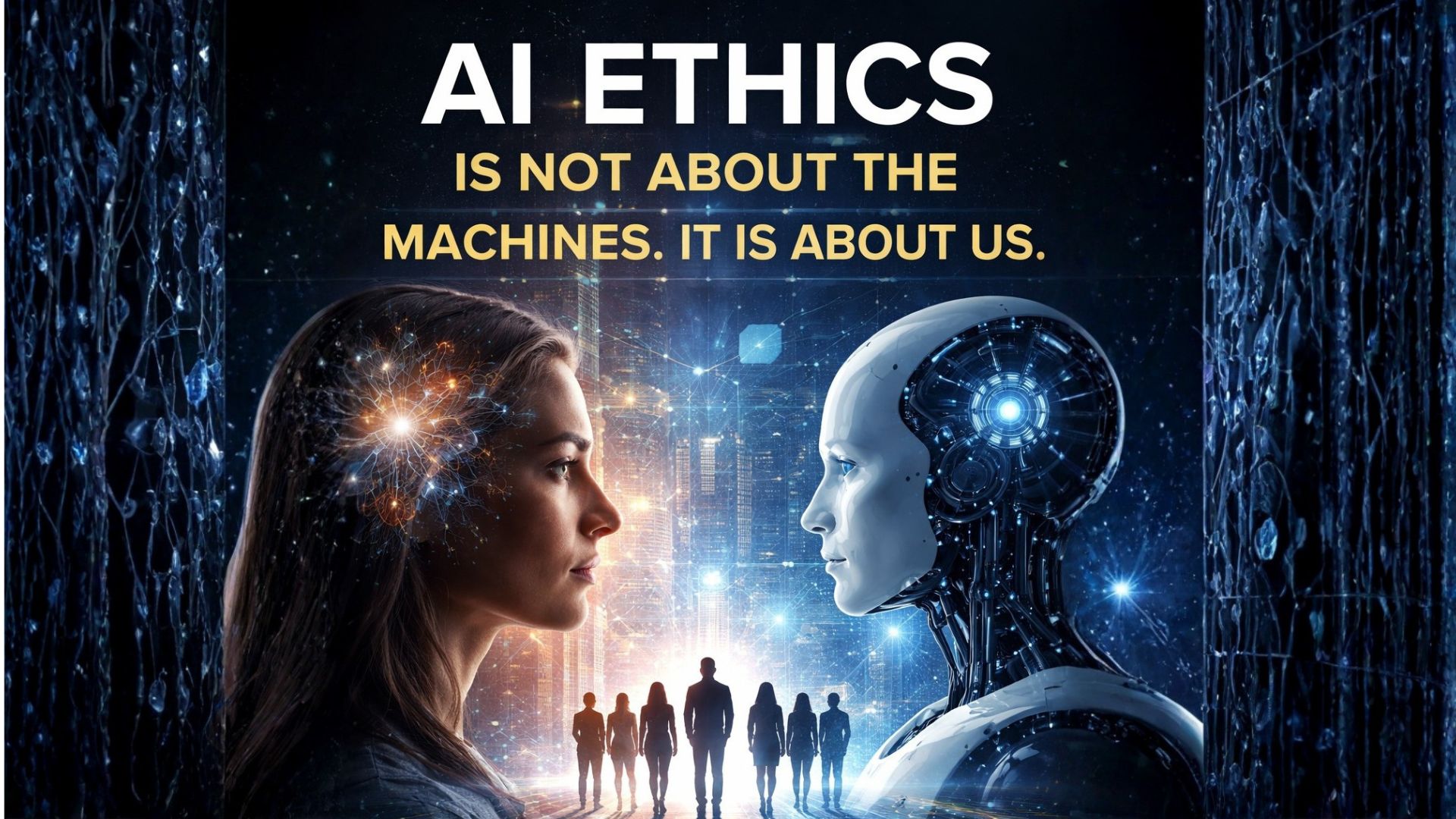
AI Ethics Is Not About Machines
Introduction
Let’s start with a simple question.
If you were handed the most powerful decision-making tool in human history, would you trust yourself to use it wisely under pressure?
That is where we are with AI.
Governments are integrating AI into intelligence and defense systems [4]. Companies like Anthropic are building increasingly powerful models while emphasizing safety [3]. And businesses everywhere are trying to figure out how fast they should move.
In reality, it looks more like a high-speed race where the guardrails are still being installed.
AI ethics is not primarily a technology problem. It is a leadership and incentive problem shaped by how decisions are made under pressure.
We are not just building smarter systems; we are building them faster than we can govern them.
The AI Race Feels Familiar, Because It Is
Think about AI like a high-performance sports car.
Now imagine driving it at full speed while the road is still unfinished.
Every company says safety matters. Every government says responsible use is critical.
But no one wants to slow down.
Why?
Because slowing down feels like losing.
Tristan Harris from the Center for Humane Technology has been warning about this exact dynamic for years. His argument is simple. The system rewards speed, not restraint [1][2].
And when speed wins, ethics often becomes a talking point instead of a constraint.
In a race driven by speed, ethics becomes optional unless it is structurally enforced.
Anthropic, OpenAI, and the Safety Signal
Here is what many leaders are asking.
Are AI companies truly prioritizing safety, or are they signaling safety while still racing ahead?
Anthropic has introduced its Responsible Scaling Policy, which outlines how it evaluates risk as models become more capable [3].
That matters.
But here is the sharper question.
Can any company afford to slow down if its competitors do not?
That tension defines the moment.
Public safety commitments matter, but the real test is whether governance holds when competitive pressure intensifies.
When Governments Enter the Chat
Now consider government adoption.
The United States and other nations are embedding AI into national security and public systems, a trend reinforced by policy frameworks like the 2023 Executive Order on AI [4].
It becomes infrastructure.
And once it becomes infrastructure, the incentives shift again.
Ask yourself:
If another country gains an AI advantage, would your government slow down to refine ethics?
Or accelerate to keep up?
History gives us a clear pattern.
Breakthrough first. Regulation later.
Stanford’s AI Index shows governments are increasingly treating AI as a strategic asset, a trend reinforced by ongoing research from Stanford’s Human-Centered AI Institute on governance and societal impact [5][9].
Government adoption of AI transforms it from a tool into strategic infrastructure, accelerating both innovation and risk.
The Part Most People Miss
Most conversations about AI ethics focus on what is visible.
Bias. Misinformation. Job loss.
Those matter.
But they are not the root issue.
The deeper issue is this: Who controls the system, and what incentives are driving it?
Responsible AI is not just a compliance exercise; it is a strategic advantage, as explored in Responsible AI Is Smart Business [10].
Better questions:
Who controls the data and compute?
Who verifies safety claims independently?
What happens when profit and responsibility conflict?
Are we building systems we understand, or systems we hope behave?
The most important AI ethics questions are not about features. They are about control, incentives, accountability, and oversight.
The Brain Science Behind the Blind Spots
This is where it becomes personal.
In Brain Science For The Soul, I explore how humans are wired to prioritize short-term wins over long-term consequences [7].
It is not a flaw. It is biology.
But in AI adoption, it creates risk.
We move fast.
We rationalize decisions.
We assume control.
We underestimate second-order effects.
AI is not just exposing gaps in technology.
It is exposing gaps in human judgment.
AI does not replace human judgment; it amplifies it, for better or for worse.
What Tristan Harris Is Really Warning About
The work coming out of the Center for Humane Technology goes beyond technical risk.
It highlights how AI systems shape perception, influence belief, and impact decision-making at scale [6].
If social media influenced billions of people’s attention, AI has the potential to influence how information is created, interpreted, and trusted in real time.
That is a human systems issue.
Tristan Harris’s perspective is also featured in the upcoming documentary The AI Doc: Or How I Became an Apocaloptimist, which explores the growing gap between AI capability and societal readiness to manage it [8]. It underscores a critical reality: building intelligence is accelerating, but governing it is not. The film hits theaters from Focus on March 27.
AI systems do more than automate tasks. They shape attention, perception, trust, and influence at scale.
The Leadership Test No One Can Avoid
The biggest risk in AI is not the technology.
It is how humans use it under pressure.
When competitors move faster.
When investors demand results.
When fear of missing out kicks in.
That is when decisions get made.
And that is when ethics either holds or quietly disappears.
So here is the real question:
Are you adopting AI tools or building the capability to lead in an AI-driven world?
Those are not the same thing.
This leadership gap is not new, but AI is accelerating its impact, a pattern explored further in Leadership in the Age of Disruption [11].
Organizations are adopting AI faster than they are redesigning governance, accountability, and decision-making systems to support it.
What This Means for Mid-Market Leaders
Across industries, a clear pattern is emerging. Organizations are deploying AI faster than they are redesigning decision-making, governance, and accountability structures around it.
In financial services, AI is influencing risk models before oversight frameworks fully adapt. In healthcare, AI is accelerating diagnostics while raising questions about liability and clinical judgment. In enterprise operations, teams are using generative AI to improve productivity without clear policies governing data exposure or validation. Technology is advancing faster than the human systems required to guide it. The leaders who recognize this gap early will not just reduce risk. They will build organizations that are more resilient, adaptive, and trusted.
AI adoption without human system alignment creates a hidden risk that compounds over time rather than immediate failure.
The organizations that close this gap first will not only reduce risk, they will define the standards others are forced to follow.
What Actually Matters
To stay ahead, shift your focus.
From tools to systems.
From capability to governance.
From speed to alignment.
Watch:
Incentives, not just intentions
Governance, not just innovation
Human behavior, not just machine output
Adaptability, not just efficiency
Because AI amplifies what already exists.
The organizations that succeed with AI will be those that align human performance, governance, and technology, not just deploy tools.
Key Takeaways
· AI ethics is driven by incentives and leadership decisions, not just technology
· Organizations are deploying AI faster than they are redesigning governance systems
· AI amplifies human judgment, making leadership quality a critical risk factor
· Government adoption of AI accelerates both innovation and systemic risk
· Organizations that align human performance, governance, and AI will define the future
FAQs
What is the biggest risk in AI adoption?
The biggest risk is misaligned incentives that prioritize speed and capability over governance, accountability, and responsible oversight.
Why is AI ethics a leadership issue in organizations?
AI ethics is a leadership issue because AI amplifies human decision-making, meaning poor judgment scales risk while strong leadership creates leverage.
What role does government play in AI ethics and governance?
Government adoption turns AI into strategic infrastructure, increasing both its impact and the urgency of regulation and oversight.
Why is human performance critical in AI adoption?
AI systems reflect and amplify the quality of human decisions, making leadership capability and human performance central to outcomes.
How can organizations implement AI responsibly in business?
Organizations can implement AI responsibly by aligning AI deployment with governance frameworks, human performance development, and long-term strategic oversight.
A Smarter Way Forward
At MarketTecNexus, we take a different approach.
We do not start with the technology.
We start with the human system.
Our AI Consulting and Neuro AI Implementation services are built on a clear principle.
AI without human performance = risk.
AI with optimized human performance = leverage.
That is what sets us apart.
We are leaders in AI adoption, AEO discoverability, human performance, and organizational adaptability.
Because the future will not be won by those with the most powerful tools.
It will be led by those who know how to use them responsibly.
If you are ready to move beyond AI hype and build something ethical, strategic, and sustainable, MarketTecNexus is ready to help you do it right.
References
[1] Center for Humane Technology. "The AI Dilemma."
https://www.humanetech.com
[2] Harris, Tristan. Public talks and interviews on AI incentives and governance.
[3] Anthropic. "Responsible Scaling Policy."
https://www.anthropic.com
[4] The White House. Executive Order on Safe, Secure, and Trustworthy Artificial Intelligence, 2023.
https://www.whitehouse.gov
[5] Stanford University. AI Index Report 2024.
https://aiindex.stanford.edu
[6] Center for Humane Technology. Research on AI and digital influence systems.
https://www.humanetech.com
[7] Vela, Adriana. Brain Science For The Soul. Author.AdrianaVela.Expert
[8] The AI Doc: Or How I Became an Apocaloptimist trailer coverage.
https://www.hollywoodreporter.com/movies/movie-news/ai-doc-or-how-i-became-an-apocaloptimist-movie-trailer-1236506866/#:~:text=The%20new%20trailer%20comes%20on,from%20Focus%20on%20March%2027
[9] Stanford Institute for Human-Centered Artificial Intelligence (HAI). Publications and research updates on AI governance and societal impact.
https://hai.stanford.edu
[10] Vela, Adriana. Responsible AI Is Smart Business.
https://markettecnexus.com/post/responsible-ai-is-smart-business
[11] Vela, Adriana. Leadership in the Age of Disruption.
https://markettecnexus.com/post/Leadership-in-the-Age-of-Disruption
About the author
Adriana Vela is an award-winning entrepreneur, bestselling author, Certified AEO specialist, and Certified AI Consultant. She fuses neuroscience, systems thinking, and AI strategy to create transformational frameworks that elevate leaders and optimize organizational performance. As a leader in integrating AI adoption, AEO discoverability, human performance, and organizational adaptability, she helps leaders future-proof their companies and personal brands.